Christian Schools of the Future: What Will Truly Matter?
Christian Schools of the Future: What Will Truly Matter?
There is a quiet shift happening in education.
Many school leaders can feel it.
The old models are straining under the weight of:
- staff burnout
- escalating complexity
- behaviour challenges
- rapid technological change
- workforce shortages
- anxious students
- exhausted families
- rising expectations
At the same time, artificial intelligence is accelerating faster than most schools can fully comprehend. The question many Christian school leaders are beginning to ask is no longer:
“How do we improve the current system?”
The deeper question is:
“What kind of schools will truly flourish in the future?”
Not merely survive but flourish.
The Future Will Not Belong to the Most Industrial Schools
For decades, many schools were built around an industrial model:
- standardisation
- compliance
- efficiency
- age-based progression
- information delivery
- uniformity
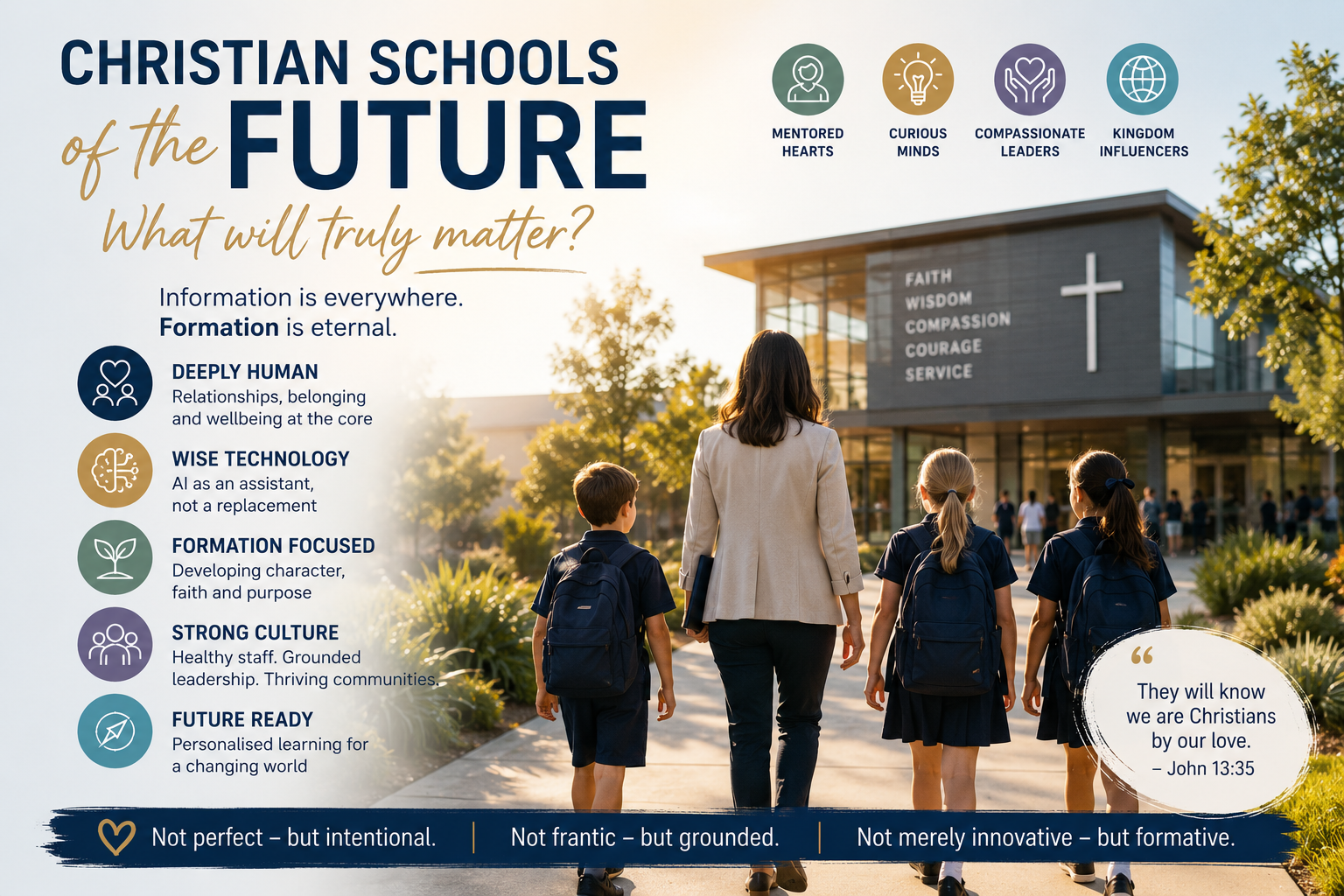
That model made sense in a different era but today’s world is different. Students can access information instantly. AI can generate essays, explanations, lesson supports and content within seconds. The future value of schools will not primarily be information. It has to be formation.
The great paradox of the future is that the more technology and artificial intelligence advances and becomes part of our world, the more human schools must become! Christian schools are uniquely positioned here because families are increasingly searching for:
- belonging
- wisdom
- values
- identity
- hope
- emotional safety
- purpose
- healthy relationships
They are not merely looking for academic outcomes. They are looking for places where their children can flourish as whole people. The schools of the future will likely not be known only for impressive facilities or ATAR/university entrance results. They may instead become known for:
- strong culture with morals and values
- grounded leadership
- healthy staff
- wise technology use
- student wellbeing
- meaningful discipleship
- authentic community
AI Will Change Education — But It Cannot Shepherd People
Artificial intelligence will undoubtedly transform education. It will assist with:
- lesson planning
- differentiation
- administrative tasks
- personalised learning
- feedback support
- accessibility
- communication systems
Schools that resist AI entirely may struggle. However, schools that allow AI to replace human wisdom, discernment and relationships may lose something essential.
AI can generate information, but it cannot:
- genuinely care
- spiritually discern
- mentor
- encourage
- inspire
- build trust
- create belonging
The future teacher has to become less like a content-deliverer and more like:
- mentor
- coach
- guide
- encourager
- culture-builder
- wisdom-former
That is extremely encouraging for those in Christian education as this is their ‘bread and butter!” Love, care and the encouraging good news of the Gospel are the very foundation of Christian schools – or at least, should be!
The Future Christian School Must Care for Its Staff
One of the greatest risks facing education is not technology. It is exhaustion.
Many Christian school leaders and teachers are quietly carrying enormous emotional and spiritual loads. A school cannot sustainably disciple flourishing students while burning out its staff.
The future Christian school will need to intentionally build:
- healthy rhythms
- leadership sustainability
- professional leadership care
- wellbeing systems
- mentoring structures
- emotionally healthy cultures
- restorative practices
- supportive leadership pathways
This is not weakness; it is wisdom.
For too long, many leaders have quietly believed that strength looks like enduring at all costs—pushing through fatigue, carrying the weight alone, and absorbing pressure without pause. The reality is that this kind of leadership is not sustainable. It may hold things together for a season, but it often comes at a hidden cost. I know and have experienced this first-hand.
Burnout is expensive. It costs experienced staff who quietly step away, emerging leaders who decide it is not worth it, and cultures that slowly lose energy and morale. It affects clarity, as decision-making becomes reactive rather than thoughtful, and it strains relationships as patience wears thin. Ultimately, it impacts students, who feel the ripple effects of adult exhaustion. While the financial cost of recruitment, training, and lost continuity is significant, the human cost is far greater.
There is another way. Healthy cultures are magnetic. They draw people in, retain great staff, and create environments where people feel safe to contribute, where leaders can think clearly, and where teams collaborate rather than simply survive. In these environments, joy is not rare but present, faith is not performative but lived, and students experience calm, consistency, and genuine care. People do not simply get through the term; they grow, contribute, and choose to stay.
This kind of culture does not happen by accident. It is built intentionally through wise leadership rhythms, clear priorities, realistic expectations, shared responsibility, and a genuine commitment to staff wellbeing. It is shaped by leaders who model healthy boundaries and create space for reflection, prayer, and renewal. Leading this way requires courage and may feel countercultural in environments that reward busyness and constant output, yet over time it proves far more powerful.
Sustainable leadership is not about doing less; it is about leading differently. When leaders are anchored, supported, and healthy, everything else begins to stabilise around them. Culture strengthens, people flourish, and the school becomes a place where both staff and students can truly thrive.
The Future School Will Be More Personalised
The traditional “one-size-fits-all” approach is becoming increasingly difficult to sustain.
I believe that future school models will have to include:
- flexible learning pathways
- project-based learning
- interdisciplinary learning
- entrepreneurship opportunities
- internships
- mentorship programs
- adaptive learning technologies
- competency-based progression
Students can access any information that they want and so they will need more than content recall teaching. They will need the following skills, and teacher to teach them:
- discernment
- adaptability
- resilience
- communication
- creativity
- emotional intelligence
- leadership
- faith-grounded identity
Christian schools have a remarkable opportunity to develop students who are not merely employable…but deeply grounded.
The Most Valuable Schools May Become Formation Communities
In the future, parents may increasingly ask:
“Who is this school helping my child become?”
Not simply:
“What marks will they achieve?”
This changes the conversation entirely.
The future Christian school is well positioned to continue to be, or become, a beacon in society and place where:
- students are known deeply
- faith is integrated authentically
- leadership is developed intentionally
- wisdom is cultivated
- emotional health matters
- service is normalised
- purpose is discovered
- identity is anchored in Christ
That kind of school becomes profoundly attractive in a fragmented world.
Christian Schools Have a Rare Opportunity
This moment is not only disruptive. It is also missional. Christian schools have an opportunity to model:
- hope in anxious times
- wisdom in noisy times
- peace in pressured times
- humanity in technological times
- belonging in isolated times
The future does not simply need smarter students. It needs wise, resilient, compassionate, grounded young people who can lead well in complex environments. That kind of formation does not happen accidentally. It happens intentionally.
The Leaders of the Future Will Need Support Too
The next decade may require school leaders to navigate:
- AI ethics
- workforce shortages
- culture fatigue
- rising mental health needs
- community complexity
- rapid change
- spiritual leadership pressures
The old “carry it all alone” model of leadership is becoming increasingly unsustainable. Instead, healthy future leadership will likely require:
- reflection
- support
- mentoring
- collaboration
- renewal
- wise boundaries
- sustainable rhythms
The leaders who flourish long-term may not be the busiest or most impressive. They may simply be the most anchored.
A Hopeful Future
Despite the challenges ahead, I remain deeply hopeful about the future of Christian education. Why?
Whether they know it or not, the world is increasingly hungry for what authentic Christian schools can uniquely offer, namely:
- meaning
- wisdom
- compassion
- belonging
- purpose
- grounded identity
- hope
The future of Christian schooling will be shaped by leaders and communities who choose to be deliberate—clear about their purpose, thoughtful in their decisions, and aligned in what truly matters. Intentional schools do not drift with every new trend or react to every pressure. They move with clarity, anchored in their mission and values, making decisions that reflect who they are called to be.
They are not merely innovative, but formative. Innovation certainly has its place, especially as technology continues to reshape education, but innovation alone is not enough. The deeper question is always what kind of people are being formed. Formative schools focus not only on what students know, but on who they are becoming—their character, their values, their faith, their capacity to lead and to serve. Every decision, every structure, and every learning experience is shaped with this in mind.
This is the kind of school that will stand out in the future. Not flawless, not rushed, and not driven by innovation for its own sake, but intentional in purpose, grounded in approach, and deeply committed to forming young people who can flourish with wisdom, resilience and faith.
How EasyEd and Permission To Pause Can Support Christian Schools of the Future
As schools navigate increasing complexity and change, I believe leaders need more than strategy alone. They need support, encouragement, practical tools and sustainable leadership care.
Through EasyEd and Permission To Pause, I support Christian school leaders through:
- leadership wellbeing support
- professional leadership care
- sustainable leadership coaching
- faith-informed leadership development
- leadership reflection tools
- practical leadership resources
- staff wellbeing frameworks
- leadership mentoring
- first-year principal support
- restorative leadership approaches
- leadership reset programs
- Christian leadership communities
- AI and future-focused leadership conversations
The future of Christian education matters deeply. Healthy leaders will help shape healthy schools; healthy schools help shape flourishing young people and flourishing young people can change the world!
Sharon Kotzur